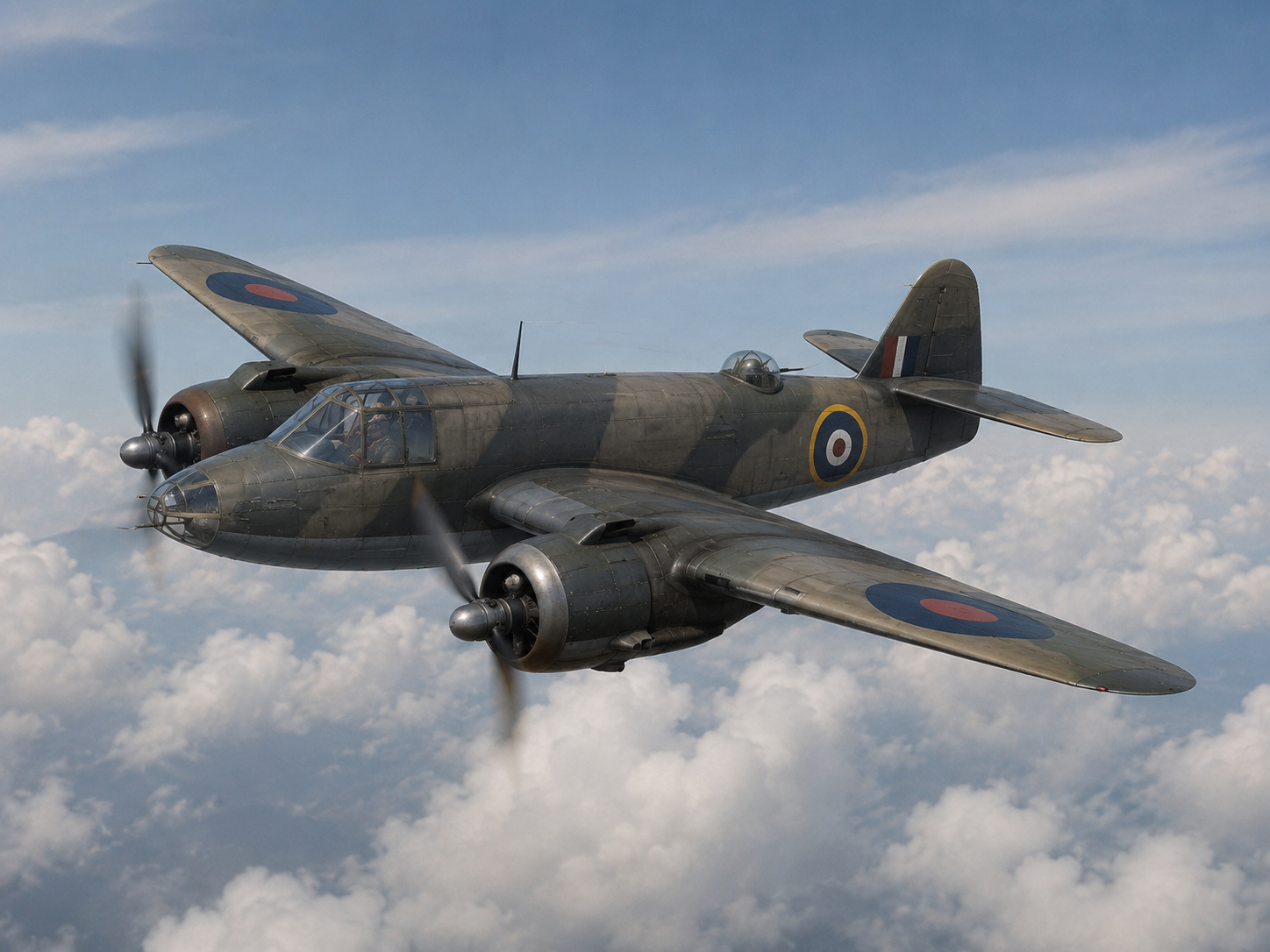
Beaufighter operations · 1940–1950s
The Beaufighter moved from heavy fighter and night interceptor into one of the RAF’s hardest-hitting strike aircraft. For modellers, the exact role drives the build: radar aerials for night fighters, torpedo gear for TF.X aircraft, rockets for anti-shipping work, desert filters for Mediterranean subjects and very heavy staining around the Hercules engines.

Role & strengths
- Heavy cannon-armed fighter and night fighter
- Coastal Command torpedo and rocket strike aircraft
- Hercules radial staining and oil-weathering focus
- Mediterranean, North Sea and Far East schemes
- Strong crew, squadron and strike-operation story routes
Key theatres
- Night defence of Britain
- North Sea and Norwegian anti-shipping strikes
- Mediterranean and North Africa
- Burma, Australia and Far East operations
Specification TF.X
Survivors today

Beaufighter survivors and restorations are especially useful for cockpit glazing, cannon nose, Hercules nacelles, undercarriage stance, radar/strike fit and heavy radial staining.
View survivorsTimeline highlights
Build this Beaufighter as…
Choose the role first. A night fighter, Mediterranean strike aircraft, North Coates or Dallachy torpedo aircraft and Far East Beaufighter all need different aerials, stores, colours and weathering.
Aircraft identity
Do not mix night-fighter radar, torpedo gear and rocket rails without checking the specific aircraft. Beaufighter fits changed by mark and theatre.
Radial engine grime is a major feature. Exhaust, oil and fuel staining should be stronger than on many single-engine RAF fighters.
Paint scheme cards
Use restrained black modulation, radar aerial detail and subdued markings.
Core torpedo/strike route with salt fading, oil staining and hard maritime wear.
Mediterranean Beaufighters need dust, sun fading, filter grime and rough forward-base servicing.
Humidity, mud, faded paint and theatre markings make Far East subjects distinct.
Campaign cards
Use 25, 29, 604 or 409 Squadron routes. Focus on radar aerials, black finish and pilot/radar operator crews.
Use 236, 254, 455 or 489 Squadron routes. Torpedoes, rockets, salt and heavy radial staining dominate.
Use 272 and 252 Squadron style subjects. Dust, sun, filters and anti-shipping operations shape the build.
RAAF and RAF Beaufighters in Burma/Pacific service need tropical fading, rough strips and heavy operational grime.
Build difficulty and related guides
Medium-high. The airframe is straightforward, but engines, nacelles, stores and aerials require planning.
High. Torpedo, rocket, bomb and radar fits must match mark, squadron and theatre.
High. Easy to underdo: radial staining, salt/dust and oil are central to the look.
RAF Beaufighter squadrons and units
Sortable Beaufighter unit cards covering night fighter, Coastal Command, torpedo, Mediterranean and Far East modelling routes.
Beaufighter operating map
Airfield info
Click a marker to show linked Beaufighter unit cards and modelling notes.
Campaign timeline
Survivors
Books and reference sources
Beaufighter build guide
Beaufighter videos, photos and archive material
Media replaces the old separate walkaround tab: cockpit, exhaust, undercarriage, markings, survivor references, archive imagery and video cards are grouped here.