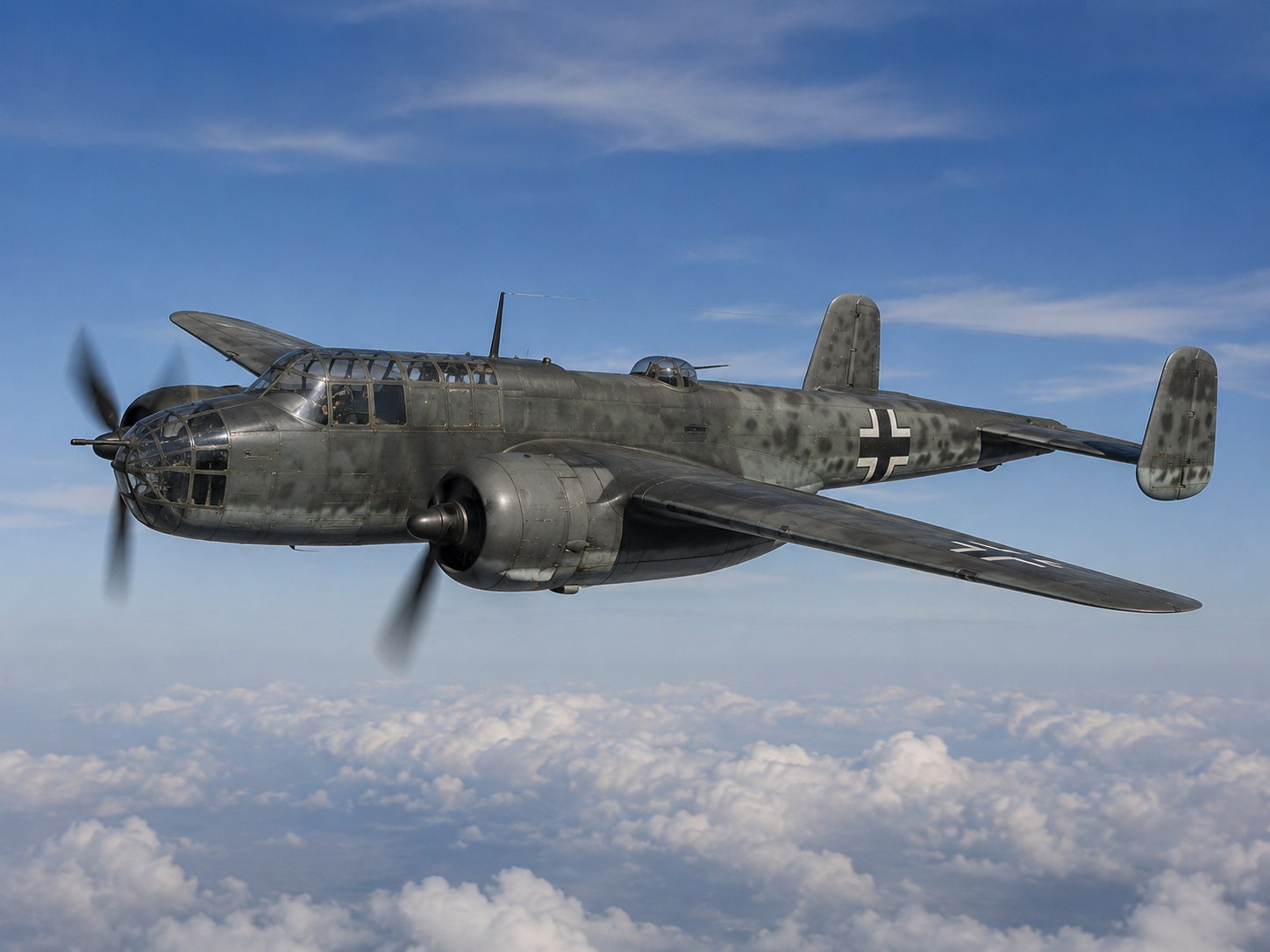
Do 17 operations · 1937–1941
The Dornier Do 17 was designed around speed and a slim fuselage, earning the “Flying Pencil” nickname. It served in Spain, Poland, France, the Low Countries and the Battle of Britain before being overtaken by larger bomber types. For modellers, the Do 17 is about slender proportions, twin-tail alignment, glasshouse nose work, early RLM splinter camouflage, KG codes and careful bomber weathering.

Role & strengths
- Early Luftwaffe fast bomber and reconnaissance aircraft
- Spanish Civil War, Poland, France and Battle of Britain routes
- Distinctive slim fuselage, twin fins and compact glazed crew compartment
- RLM 70/71/65 splinter, large KG codes and bomber weathering
- Unique RAF Museum Cosford recovery/survivor reference route
Key theatres
- Spain and pre-war operational development
- Poland and France early-war campaigns
- Battle of Britain daylight raids
- Reconnaissance and early bomber operations
Specification Do 17Z-2
Survivors today

The RAF Museum Cosford Do 17 recovery is the key survivor route. Use it for structure, nacelles, nose glazing, tail layout and weathered airframe reference, but be careful using wreck condition as a paint guide.
View survivorsTimeline highlights
Build this Do 17 as…
Pick the route first. A Spanish/pre-war Do 17, a Poland/France bomber, a Battle of Britain Do 17Z, a reconnaissance aircraft and the Cosford survivor route all need different markings and weathering logic.
Aircraft identity
Do 17E, M, P and Z versions differ. Check nose glazing, engines, defensive guns, bomb bay and tail details before committing.
The Cosford recovery is invaluable structurally, but wreck corrosion is not a normal operational weathering guide.
Paint scheme cards
Core Do 17Z Battle of Britain and early-war bomber finish.
Use restrained exhaust, slight fading, readable KG codes and clean glazing.
Recon routes need cleaner finishes, camera/mission logic and less random bomb grime.
Use for structure and restoration-story reference, not as a generic combat weathering recipe.
Campaign cards
Early bomber route with RLM 70/71/65 splinter, clean bomber codes and moderate operational wear.
KG 2, KG 3 and KG 76 Do 17Z routes with daylight raid weathering and clear KG identity.
Do 17P/M routes need mission-specific markings, cleaner finish and camera/recon logic.
The recovered Goodwin Sands aircraft gives a unique reference/story section and structural interest.
Build difficulty and related guides
High. Slender fuselage seams, twin fins, clear parts and engine nacelle alignment need patience.
High. The nose and cockpit glazing need masks and careful internal painting.
Medium-high. The twin tail, nacelles and long fuselage show alignment errors quickly.
Do 17 Kampfgeschwader units
Sortable Do 17 unit cards covering early bomber campaigns, Battle of Britain, reconnaissance and the Cosford survivor route.
Do 17 operating map
Airfield info
Click a marker to show linked Do 17 unit cards and modelling notes.
Campaign timeline
Survivors
Books and reference sources
Do 17 build guide
Do 17 videos, photos and archive material
Media replaces the old separate walkaround tab: cockpit, exhaust, undercarriage, markings, survivor references, archive imagery and video cards are grouped here.