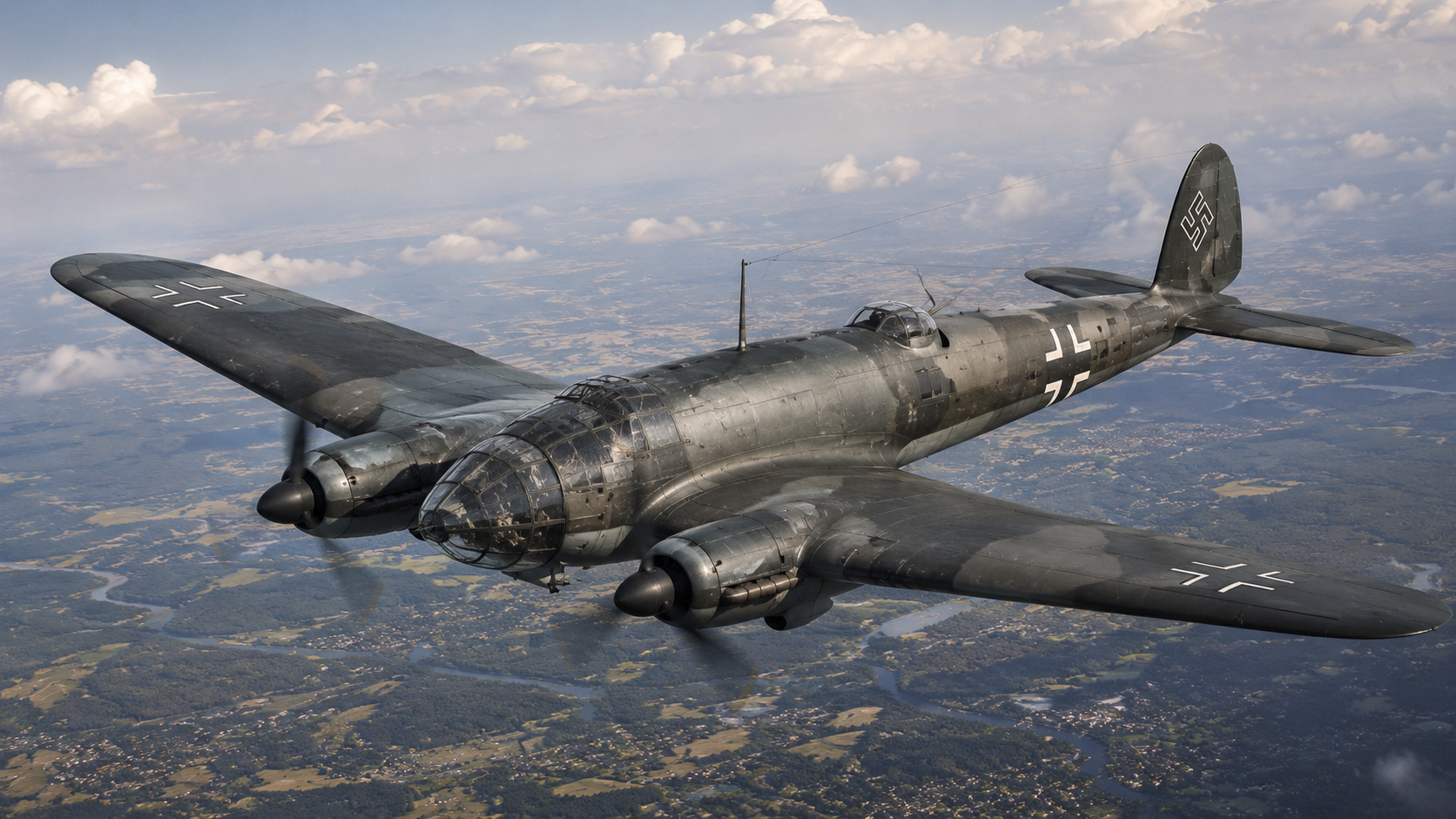
He 111 operations · 1939–1945
The He 111 served from the opening campaigns through the final years of the war. It was central to the Blitz over Britain, then adapted to night bombing, Mediterranean operations, Eastern Front supply and torpedo attacks. Its modelling challenge is different from single-seat fighters: long seams, clear parts, interior visibility, defensive gun positions, engine staining, bomb bay/loadout choices and large splinter-camouflage surfaces.

Role & strengths
- Luftwaffe medium bomber and torpedo bomber
- Poland, France, Battle of Britain, Blitz, Mediterranean and Eastern Front routes
- Large glass nose, cockpit interior and defensive gun stations
- Splinter camouflage, night black undersides, yellow theatre markings and exhaust staining
- Bomb bay, external racks, torpedoes and supply/transport adaptations
Key theatres
- Poland, France and early-war bomber campaigns
- Battle of Britain and Blitz night bombing
- Mediterranean, Malta and North Africa routes
- Eastern Front and torpedo-bomber operations
Specification He 111H-6
Survivors today

Surviving and preserved He 111 airframes are useful for the glazed nose, cockpit framing, dorsal/ventral gun positions, engine nacelles, undercarriage and large bomber proportions.
View survivorsTimeline highlights
Build this He 111 as…
Pick the bomber route first. A Battle of Britain He 111P/H, a Blitz night bomber, a Mediterranean aircraft, an Eastern Front supply/bomber and a torpedo He 111H all need different undersides, markings and loadout decisions.
Aircraft identity
The He 111 is dominated by glazing. Canopy masks and careful interior planning are not optional if you want a clean result.
He 111P, H bomber, H-6 torpedo and transport/supply routes differ. Check nose, guns, racks, torpedoes and underside colour first.
Paint scheme cards
Poland, France and Battle of Britain routes use classic bomber splinter over blue.
Night bomber builds need black undersides, exhaust staining and reduced-contrast weathering.
Mediterranean aircraft need sun fading, dust, yellow areas and heavy engine staining.
Torpedo He 111H builds need external torpedoes/racks, sea-weathering and mission-specific references.
Campaign cards
KG 26, KG 53 and KG 55 He 111P/H aircraft with RLM 70/71/65, large codes and bomber weathering.
Night bomber route with black undersides, exhaust staining, toned markings and long-distance grime.
Dust, sun, yellow theatre markings and hard engine/nacelle staining.
KG 26 and maritime routes need torpedo racks, sea grime, faded finish and specific H-6 references.
Build difficulty and related guides
High. Large airframe seams, clear parts, interior visibility and twin-engine alignment all need patience.
Very high. The greenhouse nose and cockpit framing make masks strongly recommended.
High. Exhaust staining, black undersides, bomber grime and large splinter surfaces need restraint.
He 111 Kampfgeschwader units
Sortable He 111 unit cards covering early bomber campaigns, Battle of Britain, Blitz night bombing, Mediterranean, Eastern Front and torpedo-bomber routes.
He 111 operating map
Airfield info
Click a marker to show linked He 111 unit cards and modelling notes.
Campaign timeline
Survivors
Books and reference sources
He 111 build guide
He 111 videos, photos and archive material
Media replaces the old separate walkaround tab: cockpit, exhaust, undercarriage, markings, survivor references, archive imagery and video cards are grouped here.