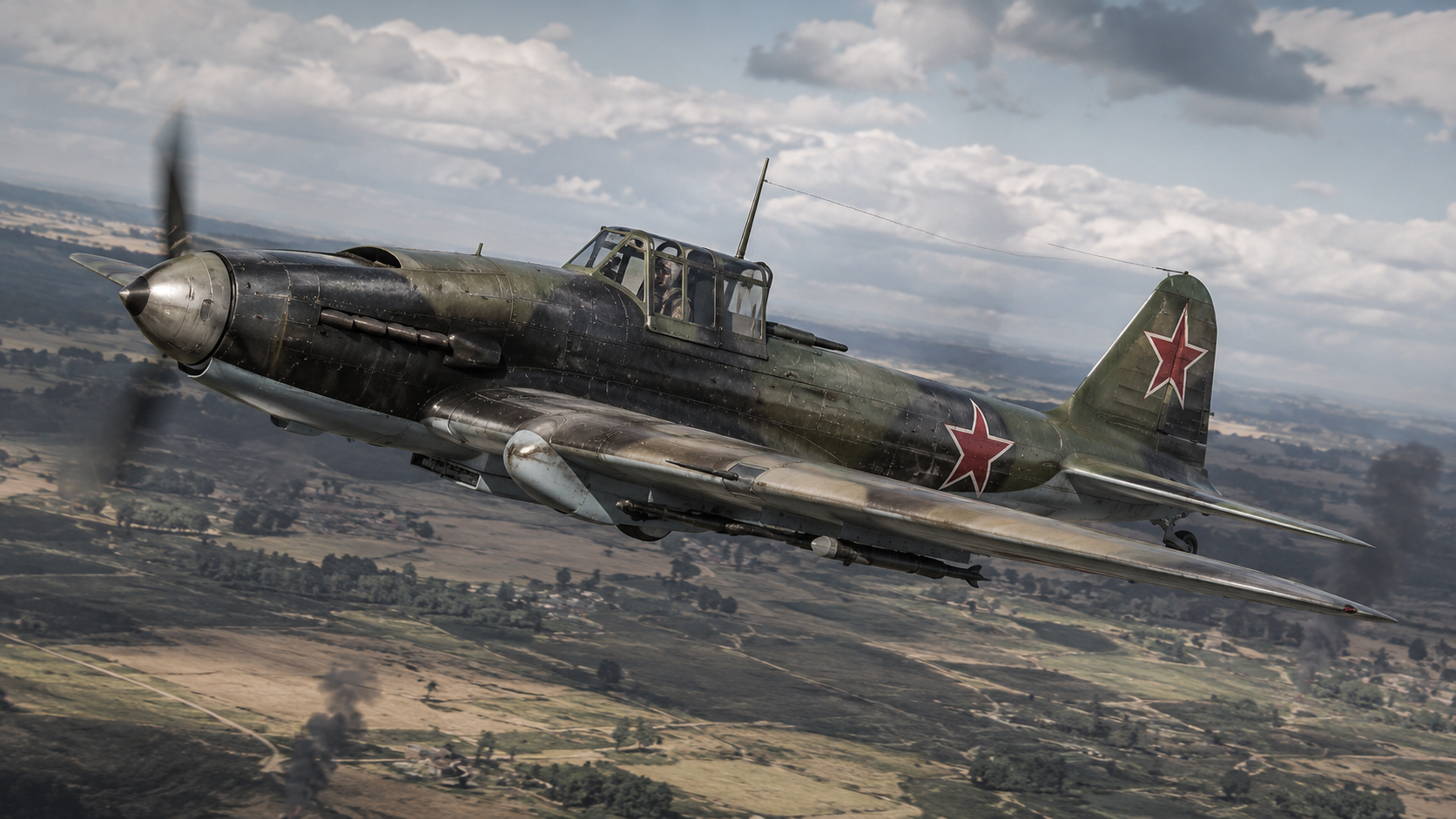
Il-2 operations · 1941–1945
The Il-2 was built for the Eastern Front: low altitude, brutal conditions, dispersed airfields and constant close-support work. Early single-seat aircraft gave way to two-seat machines with rear gunners, while late Il-2M3 builds became the iconic Sturmovik shape. Modelling one well means thinking like an assault unit: mud, dust, oil, exhaust, rocket rails, patched panels, winter whitewash and field-applied camouflage.

Role & strengths
- Armoured Soviet ground-attack aircraft and close-support platform
- Moscow, Stalingrad, Kursk, Bagration, Poland and Berlin routes
- Single-seat, two-seat, arrow-wing and late Il-2M3 variant decisions
- AMT-4/6/7 and later three-colour camouflage, winter whitewash and red stars
- Rocket rails, bombs, cannons, armoured cockpit and rough-field weathering
Key theatres
- Defence of Moscow and early-war emergency production
- Stalingrad and southern front ground attack
- Kursk anti-armour and close-support routes
- Operation Bagration, Poland and Berlin late-war routes
Specification Il-2M3
Survivors today

Surviving Il-2s are useful for armour shape, wing planform, cockpit framing, radiator, landing gear stance, rocket rails and red-star placement.
View survivorsTimeline highlights
Build this Il-2 as…
Pick the front and variant first. A single-seat 1941 aircraft, a Stalingrad two-seater, a Kursk anti-armour aircraft, a winter whitewashed Sturmovik and a late Berlin/Bagration machine all need different finish logic.
Aircraft identity
Single-seat, two-seat, straight-wing and arrow-wing Il-2s differ. Check canopy, rear gunner, wing shape and weapons before choosing decals.
Il-2s can be filthy, but keep it logical: mud on gear, oil around engine, rocket soot, foot traffic and whitewash wear by airflow/contact.
Paint scheme cards
Early and mid-war route with green/black uppers and blue-grey lower surfaces.
Late-war Sturmoviks can use green/brown/dark grey patterns with strong field variation.
Whitewash should wear at wing roots, leading edges, panels and airflow paths.
Ground-attack weathering should concentrate around gear, belly, exhaust and weapons.
Campaign cards
Early single-seat Sturmoviks with urgent production, simple markings and harsh survival context.
Two-seat aircraft, rough strips, winter/dust transition and heavy close-support wear.
Anti-armour route with rockets/bombs, dust, oil and intense ground-attack weathering.
Late Il-2M3 subjects with Guards markings, red stars and field-worn three-colour camouflage.
Build difficulty and related guides
Medium-high. Shape, canopy, weapons and rugged finish are manageable, but variant choice matters.
High. Single/two-seat, wing type and weapons fit can easily be mismatched.
Very high. Mud, whitewash, oil and rocket grime need layering rather than random dirt.
Il-2 ShAP and Guards assault units
Sortable Il-2 unit cards covering early-war ShAP units, Guards assault regiments, Kursk, Stalingrad, Bagration, Berlin and Polish/survivor routes.
Il-2 operating map
Airfield info
Click a marker to show linked Il-2 unit cards and modelling notes.
Campaign timeline
Survivors
Books and reference sources
Il-2 build guide
Il-2 videos, photos and archive material
Media replaces the old separate walkaround tab: cockpit, exhaust, undercarriage, markings, survivor references, archive imagery and video cards are grouped here.