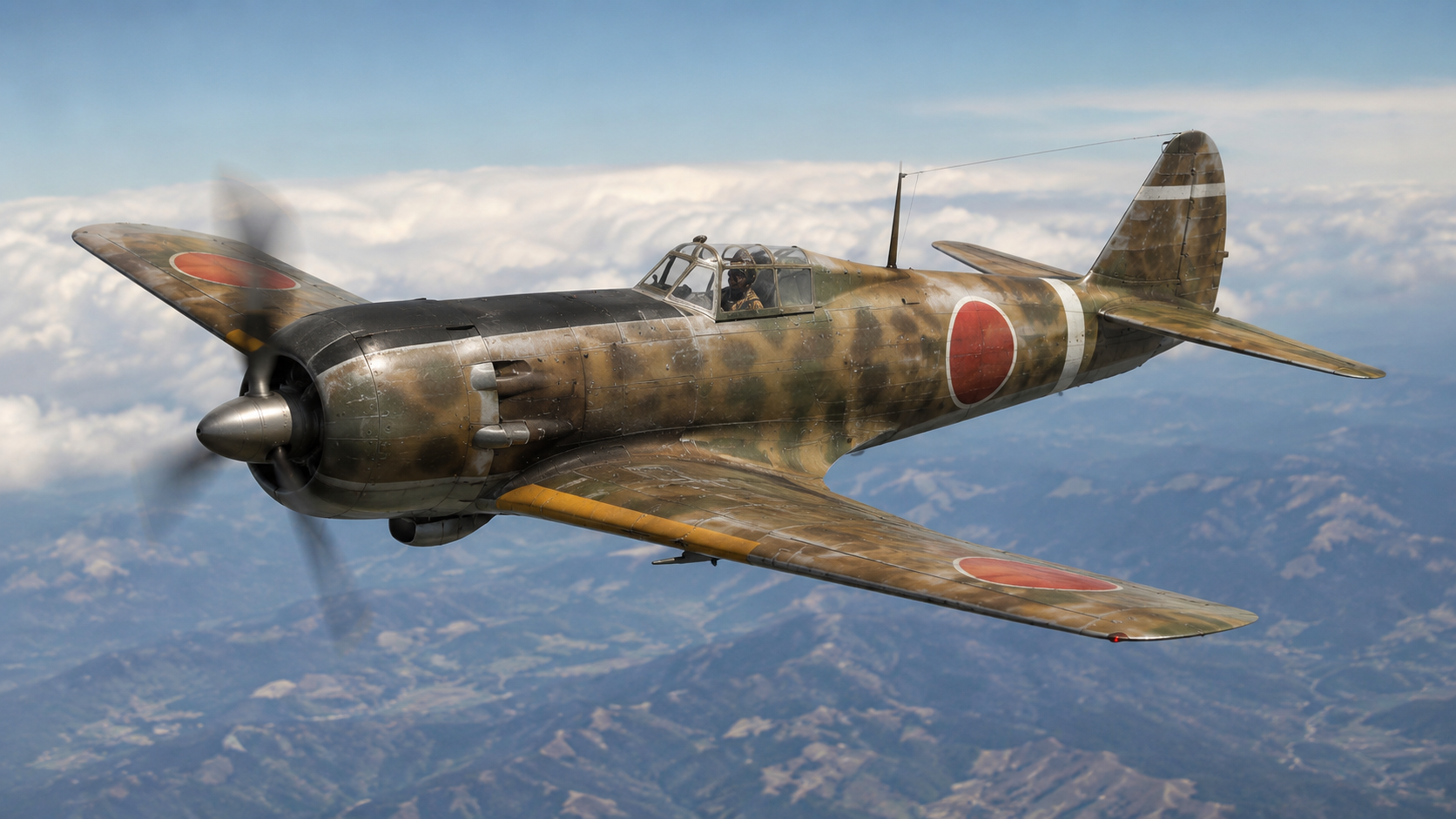
Ki-43 operations · 1941–1945
The Ki-43 Oscar served across almost every major Japanese Army air front. It was agile and long-ranged, but lightly armed and vulnerable compared with later Allied fighters. A good Ki-43 model starts with the theatre and Sentai: early natural-metal Ki-43-I, Burma/China camouflaged aircraft, New Guinea heavily weathered fighters, late Ki-43-II/III subjects, or survivor/wreck reference route.

Role & strengths
- Imperial Japanese Army Air Force light fighter and escort/interceptor aircraft
- Malaya, Burma, China, New Guinea, Philippines and homeland defence routes
- Light airframe, radial engine, simple canopy, Sentai tail flashes and Army camouflage
- Natural metal, green mottle, brown/green field camouflage and late-war dark green over grey
- Tropical fading, chipped paint, dusty landing gear, exhaust staining and rough field repairs
Key theatres
- Malaya/Singapore early-war route
- Burma and China theatre Sentai routes
- New Guinea and Philippines heavy-weathering routes
- Late-war homeland defence and survivor/wreck reference routes
Specification Ki-43-II
Survivor/reference today

Ki-43 references use survivors, wrecks, replicas and period photos. Use them for shape, cockpit and landing gear, but verify theatre paint and Sentai markings separately.
View referencesTimeline highlights
Build this Ki-43 as…
Pick the Sentai and theatre first. A Malaya natural-metal aircraft, Burma camouflaged fighter, New Guinea worn subject, Philippines late fighter or survivor route all need different finishes.
Aircraft identity
Sentai tail markings are highly visible and theatre/date-specific. Do not use generic Japanese markings without checking the unit.
Ki-43 finishes vary massively: natural metal, mottled green, field-applied brown/green and dark green routes all need different weathering.
Paint scheme cards
Early Malaya/Burma route with polished or dulled metal and Sentai flashes.
Burma/China/New Guinea route with field-applied paint and high variation.
Late Ki-43-II/III route with faded green, exhaust and stronger operational wear.
Weather tyres, wing roots, cowling, exhausts and field repairs logically.
Campaign cards
Early-war Ki-43 route with natural metal and sharp Sentai markings.
Mottled and field-camouflaged aircraft with dust, heat and improvised finishes.
Heavy tropical wear route with fading, chipping, dust and rough field maintenance.
Late Ki-43-II/III route with darker green, heavy service and desperate defence context.
Build difficulty and related guides
Medium. Simple airframe, but finish and markings make or break the model.
High. Sentai markings and theatre/date accuracy matter heavily.
High. Natural metal, mottle and tropical chipping require restraint.
Nakajima Ki-43 Oscar Sentai and IJAAF units
Sortable Ki-43 cards covering Malaya, Burma, China, New Guinea, Philippines, late-war and survivor/reference routes.
Ki-43 Oscar operating map
Airfield info
Click a marker to show linked Ki-43 unit cards and modelling notes.
Campaign timeline
Survivors
Books and reference sources
Ki-43 Oscar build guide
Ki-43 Oscar videos, photos and archive material
Media replaces the old separate walkaround tab: cockpit, exhaust, undercarriage, markings, survivor references, archive imagery and video cards are grouped here.