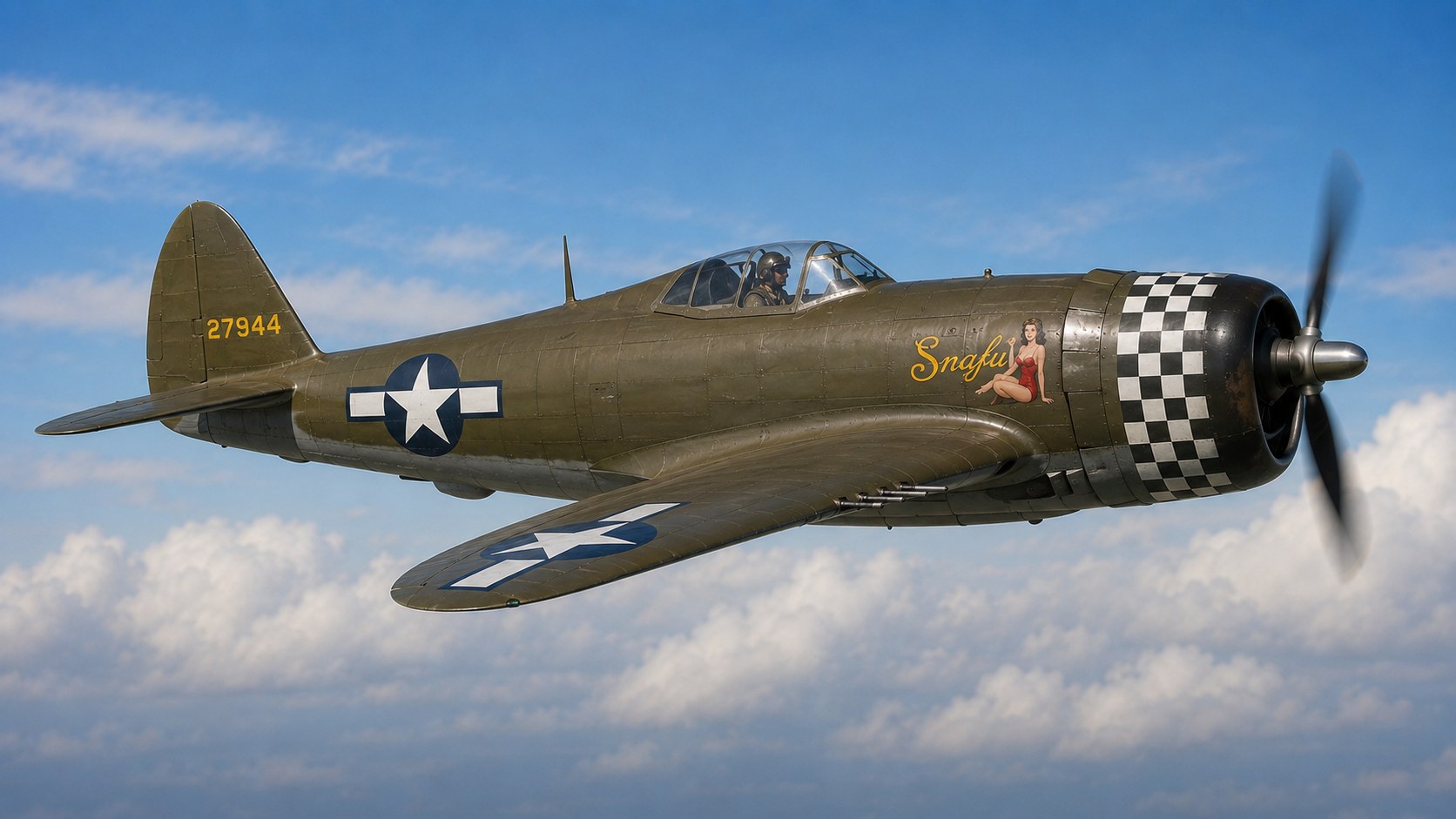
USAAF Thunderbolt operations · 1942–1945
The Thunderbolt served as high-altitude escort, dive fighter, fighter-bomber and close-support aircraft. It was famously rugged, heavily armed and capable of carrying bombs, rockets and tanks. For modellers, the route starts with the airframe: razorback or bubbletop, olive drab or natural metal, ETO or Pacific, clean escort aircraft or battered ground-attack Jug.

Role & strengths
- Heavy USAAF fighter and fighter-bomber
- Eight .50 calibre guns, bombs, rockets and drop tanks
- Razorback and bubbletop modelling routes
- Natural metal, olive drab and colourful group markings
- Huge radial engine, oil staining and rugged ground-attack weathering
Key theatres
- Eighth Air Force escort from England
- Ninth Air Force tactical support after D-Day
- Twelfth/Fifteenth Air Force Mediterranean operations
- Pacific and P-47N long-range operations
Specification P-47D
Survivors today

Surviving Thunderbolts are especially useful for cowling shape, intercooler/exhaust detail, cockpit, undercarriage stance, wing stores and natural metal finish variation.
View survivorsTimeline highlights
Build this Thunderbolt as…
Pick the variant and role first. A razorback escort P-47, a bubbletop ground-attack Jug, a Gabreski 56th FG aircraft, a Mexican/Brazilian or MTO subject, and a P-47N Pacific aircraft all require different details.
Aircraft identity
Razorback and bubbletop Thunderbolts have different silhouettes and often different block details. Do not use a P-47D bubbletop decal plan on an early razorback without checking.
The P-47 can take heavier operational wear than a clean escort Thunderbolt, but make it logical: radial oil, exhaust, gun staining, wing-root wear and ordnance grime.
Paint scheme cards
Classic razorback Thunderbolt route with heavy fading, gun staining and squadron markings.
Bubbletop P-47Ds reward subtle metal variation and bold cowling/tail colours.
Stripes can be rough, partial or overpainted depending on date and tactical unit.
Pacific aircraft need heat, sun, long-range tank wear and island-base grime.
Campaign cards
Use 56th, 78th, 353rd, 355th or 356th Fighter Group routes. Focus on OD/NMF, drop tanks and group markings.
Bombs, rockets, invasion stripes and forward airfield grime define the ground-attack Jug.
Brazilian and Mexican units provide strong theatre alternatives with distinctive markings and dusty finishes.
Long-range P-47Ns need bigger wing/tank context, sun fading and island-base weathering.
Build difficulty and related guides
Medium. Big airframe and simple lines help, but natural metal and stores still need care.
Medium-high. OD fading and NMF panel work both need restraint.
High. Tanks, bombs and rockets must match role, unit and date.
USAAF Thunderbolt fighter groups and squadrons
Sortable P-47 Thunderbolt unit cards covering Eighth Air Force escort groups, Ninth Air Force fighter-bomber units, Mediterranean/Latin American units and Pacific P-47N subjects.
P-47 Thunderbolt operating map
Airfield info
Click a marker to show linked Thunderbolt unit cards and modelling notes.
Campaign timeline
Survivors
Books and reference sources
P-47 Thunderbolt build guide
P-47 Thunderbolt videos, photos and archive material
Media replaces the old separate walkaround tab: cockpit, exhaust, undercarriage, markings, survivor references, archive imagery and video cards are grouped here.