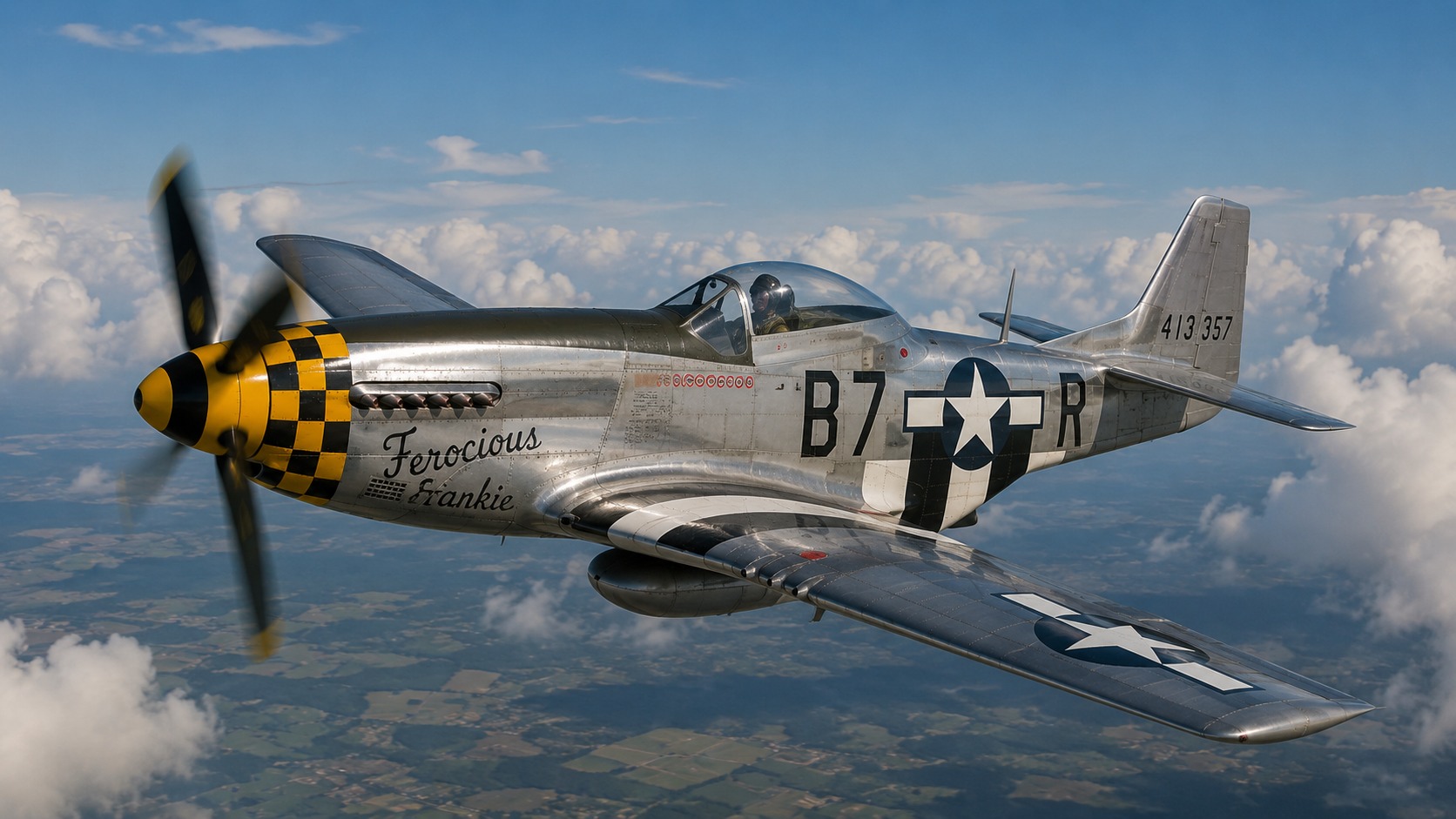
USAAF Mustang operations · 1942–1945
The Mustang transformed Allied daylight air superiority. Early Allison Mustangs served in tactical reconnaissance and low-level roles, but the Merlin-powered P-51B/C/D became the long-range escort fighter that carried USAAF fighter groups to Berlin and beyond. For modellers, the subject choice drives everything: natural metal or olive drab, Malcolm hood or bubble canopy, drop tanks, invasion stripes and group colour markings.

Role & strengths
- Long-range bomber escort and air-superiority fighter
- Natural metal, olive drab and colourful USAAF group markings
- Drop tanks, Malcolm hood, bubble canopy and fin/tail variants
- Famous named aircraft and ace-pilot subjects
- European, Mediterranean and Pacific theatre options
Key theatres
- Eighth Air Force bomber escort from England
- Ninth Air Force tactical support after D-Day
- Fifteenth Air Force Mediterranean escort
- CBI and Pacific late-war operations
Specification P-51D
Survivors today

Surviving Mustangs are excellent for natural metal variation, cockpit framing, wheel wells, radiator scoop, laminar-flow wing finish and undercarriage stance.
View survivorsTimeline highlights
Build this Mustang as…
Choose the group and variant first. A P-51B/C with Malcolm hood, a natural-metal P-51D, a 332nd Fighter Group red-tail, a D-Day tactical Mustang and a CBI Mustang all require different markings and weathering.
Aircraft identity
Many Mustang wings were filled and painted rather than left as heavily panel-lined bare metal. Do not weather the wing like every panel is exposed metal.
Tail colours, nose bands, code letters and invasion stripes changed by group and date. Pick the aircraft before choosing decals.
Paint scheme cards
Vary panels subtly but keep the wing smoother where filled/painted. Add exhaust and gun staining sparingly.
Useful for early P-51B/C aircraft and weathered escort fighters before widespread natural metal finishes.
Field-applied stripes can be rough, partial or overpainted depending on date and unit.
Red tails, yellow/black checkers, blue noses and coloured rudders make group research essential.
Campaign cards
Use 4th, 352nd, 357th, 359th or 361st Fighter Group routes. Focus on natural metal, group colours and drop tanks.
332nd Fighter Group red-tail Mustangs need Mediterranean theatre references, red tail markings and disciplined natural metal weathering.
Invasion stripes, tactical support, dust and forward-base wear define these subjects.
Long-range operations, dusty strips, sun fading and theatre markings give a different Mustang look.
Build difficulty and related guides
Medium. Kits are strong, but natural metal, canopy choice and markings can expose mistakes.
High. Natural metal needs clean prep, subtle panel variation and correct wing treatment.
High. Group colours, codes, block details and drop tanks must match the aircraft/date.
USAAF Mustang fighter groups and squadrons
Sortable P-51 Mustang unit cards covering Eighth Air Force escort groups, Ninth Air Force tactical units, Fifteenth Air Force red-tail Mustangs and CBI/Pacific modelling routes.
P-51 Mustang operating map
Airfield info
Click a marker to show linked Mustang unit cards and modelling notes.
Campaign timeline
Survivors
Books and reference sources
P-51 Mustang build guide
P-51 Mustang videos, photos and archive material
Media replaces the old separate walkaround tab: cockpit, exhaust, undercarriage, markings, survivor references, archive imagery and video cards are grouped here.