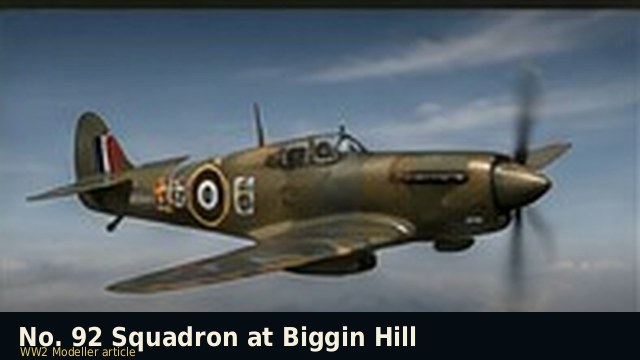
No. 92 Squadron at Biggin Hill — QJ markings guide
No. 92 Squadron was the highest-scoring Spitfire unit of the entire Battle of Britain with 127 claims — a record no other Spitfire squadron matched. Based at Biggin Hill from August 1940, they included Stanford Tuck, Brian Kingcome and the eighteen-year-old Geoffrey Wellum, whose memoir First Light is the finest account of Spitfire combat flying ever written.
92 Squadron entered the main battle in August 1940 after a brief rest at Pembrey. Based at Biggin Hill alongside Hurricane units, they were tasked primarily with engaging the Bf 109 escort fighters at altitude while Hurricanes attacked the bomber formations below. This role — harder and less statistically productive than bomber interception — nonetheless produced the highest score of any Spitfire unit.
The CO in the critical period was Sqn Ldr P.J. Sanders before being replaced by Sqn Ldr R.R.S. Tuck. Robert Stanford Tuck's 29 victories (some sources credit 30) made him one of the greatest RAF aces of the entire war. Flt Lt Brian Kingcome ('Sandy') rose to Air Vice-Marshal. Geoffrey Wellum's four kills understate his contribution — his memoir, written in the 1970s and published in 2002, gives the most precise picture of what it was actually like to fly a Spitfire from Biggin Hill in September 1940.
92 Squadron's identifying code letters were QJ. The code system placed the squadron letters on either side of the fuselage roundel, with the individual aircraft letter on one side. The format was: squadron code — roundel — aircraft letter.
The most modelled 92 Squadron aircraft is X4474 coded QJ-K, documented as one of Stanford Tuck's mounts during the battle. The code letters were Sky (BS381C-216), applied in approximately 24-inch stencilled characters by ground crew — not always perfectly aligned and spacing varied slightly between aircraft.
X4474 / QJ-K — documented Tuck aircraft, the most frequently featured in decal sheets
X4036 / QJ-B — associated with Wellum's early operations
K9954 / QJ- — early Mk.I used during the unit's conversion period
X4474 (QJ-K) was an A-scheme aircraft — Dark Earth appearing on the starboard upper nose. Photographs of 92 Squadron at Biggin Hill show a mix of A and B scheme aircraft flying together, as was standard across all units. Identify your specific serial from photographic sources before choosing a decal sheet.
Biggin Hill's chalk and flint subsoil produced a distinctive pale buff-grey contamination — very different from the darker clay at inland stations. By September 1940, after intensive operations, 92 Squadron's aircraft showed:
Pale buff-grey chalk dust on undersurfaces and undercarriage (Tamiya XF-57 + XF-2, 1:1)
Heavy exhaust staining on port upper cowling
Eight gun port blast marks on each wing leading edge
Significant cockpit sill chipping from constant entry and exit
Leading edge aluminium wear, heavier outboard
Aircraft were well-worn by September — 92 Sqn had been flying intensively for weeks and the paint surface showed accumulated operational use. Sky codes on some aircraft had been retouched in a slightly different tone as ground crew mixed their own paint.
Xtradecal X48085 — 1:48 BoB Spitfire sheet, includes 92 Sqn QJ markings. Hannants ↗
Xtradecal X72114 — 1:72 equivalent. Hannants ↗