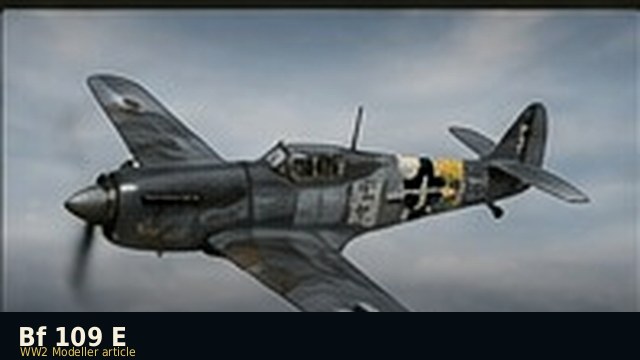
Bf 109 E-7 Tropical — North Africa schemes, paint codes & kits
The Bf 109 E-7 Trop is one of the most visually striking German aircraft of the war — a European fighter transplanted into a completely different world, wearing improvised desert camouflage and flying in conditions it was never designed for. For modellers it means a completely different palette, the distinctive Vokes tropical filter, and a wealth of colourful JG 27 unit markings.
The Bf 109 E-7 entered service in late 1940 and differed from the E-4 primarily in its fuel system, which could carry a 300-litre drop tank under the centreline for extended range. The Trop suffix indicated aircraft fitted with the Fieseler-designed dust filter over the supercharger intake — a bulbous, forward-facing scoop on the lower cowling that is the definitive visual identifier of the tropical variant.
Deployment to North Africa began in April 1941 when JG 27 transferred to Libya to support Rommel's Afrika Korps. The aircraft arrived in standard European RLM 70/71/65 or early RLM 74/75/76 schemes and were hastily repainted — or over-painted — in desert colours, producing the wonderfully chaotic variety of North Africa Bf 109 markings that makes these aircraft such attractive subjects.
The Vokes tropical air filter is the single most distinctive element of any North Africa Bf 109. It fits over the original supercharger intake on the lower cowling, creating a prominent forward-facing intake scoop that is clearly visible from any angle. Without the filter, an E-7 Trop is indistinguishable from a standard E-7 — the filter is what makes the variant immediately recognisable.
All major kit manufacturers that produce a tropical Bf 109 include the filter as a separate sprue item. On some aircraft it was removed in the field for cooling reasons, leaving the standard intake visible — reference your specific subject.
The North Africa scheme used three RLM colours: RLM 79 Sandgelb as the base coat, RLM 80 Olivgrün applied as irregular patches over the base, and RLM 78 Himmelblau on all undersurfaces. Application was variable — some aircraft had precisely defined patches, others had hasty brush-applied schemes applied in the field over whatever base scheme the aircraft arrived with.
The primary upper surface colour — a warm, sandy yellow-tan. This is the base coat over which RLM 80 patches are applied. The tone varies in period photographs from very pale buff to a deeper ochre — original batch variation was significant. Represents the dry, sandy soil of the Libyan and Egyptian deserts.
Applied as irregular patches over the RLM 79 base, with varying coverage — some aircraft show 30–40% RLM 80 coverage, others as little as 20%. The patches often follow the lines of the original European scheme applied underneath, particularly in cases where the desert scheme was overpainted in the field.
A medium sky blue for all undersurfaces — lighter and warmer than the European RLM 65. Designed to provide camouflage against the bright North African sky when viewed from below. The demarcation between RLM 78 and the upper surface colours is softer on most North Africa aircraft than the hard line typical of European schemes.
Jagdgeschwader 27 was the primary Bf 109 unit in North Africa and its aircraft are the definitive desert Bf 109 modelling subject. The Geschwader used the standard Luftwaffe identification system — aircraft letter in white, Gruppe identifier bar, and Staffel colour on the spinner or cowling ring.
I./JG 27 — No horizontal bar after the fuselage code letter. First Gruppe.
II./JG 27 — Horizontal bar after the code letter.
Individual Staffeln — Coloured spinner or cowling ring: 1st Staffel white, 2nd Staffel red, 3rd Staffel yellow, 4th Staffel blue, etc.
Many individual aircraft also carried personal markings — particularly those flown by Experten with high kill scores. Hans-Joachim Marseille's aircraft carried his tally in a distinctive format below the cockpit.
The most prolific scorer against Western Allied aircraft in the entire war — 158 confirmed aerial victories, 151 of them in North Africa, 17 in a single day on 1 September 1942. Marseille was celebrated across Germany and his aircraft markings are among the most documented of any WW2 pilot. His personal aircraft "Yellow 14" in the late phase of his career showed the distinctive desert scheme with his large kill tally displayed below the cockpit and a red heart personal emblem. He was killed on 30 September 1942 — not in combat, but when bailing out of a smoke-filled cockpit at low altitude after an engine failure. He was 22 years old.
North Africa Bf 109s showed very specific weathering patterns unlike European aircraft. The abrasive desert sand acted as a natural paint stripper, producing rapid surface wear particularly on leading edges, walkways and cowling surfaces. The sand also deposited in every crevice and gap.
Paint fading: RLM 79 bleaches rapidly in the North African sun — lighten the colour by 15–20% for weathered subjects, and add subtle variation across panels to represent differential fading.
Sand deposits: Fine buff-coloured dust (Vallejo 70.986 Deck Tan) on all horizontal surfaces, in panel lines and around the intake. Apply as a dry wash over a sealed surface.