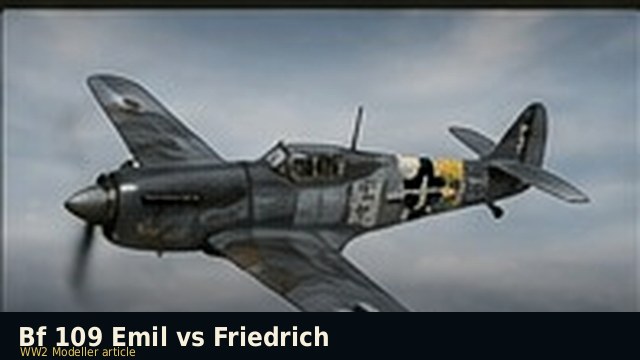
Bf 109 Emil vs Friedrich — telling them apart
The Bf 109 E (Emil) and F (Friedrich) look similar in photographs, and many modellers — particularly those newer to Luftwaffe subjects — confuse the two. Getting the variant wrong on a finished build is an embarrassing mistake that's entirely preventable. Here are the eight differences that matter.
The Emil and Friedrich were fundamentally different aircraft in terms of performance, armament and operational role. The Emil was the Battle of Britain Bf 109 — the aircraft that fought the Spitfire and Hurricane over southern England in 1940. The Friedrich was its replacement from 1941, a significantly cleaner design that introduced the engine-mounted cannon and removed the underwing guns entirely. Confusing them means producing a historically inaccurate model, and it's visible enough that an experienced modeller will notice immediately.
Within each mark there are further sub-variants that matter for accuracy. The Emil family runs from E-1 (no wing cannon, October 1938) through E-4 (main BoB variant, two wing cannon) to the E-7 (drop tank equipped, late 1940). The Friedrich family runs from the early F-1 and F-2 (20mm MG FF/M engine cannon) to the F-4 (upgraded 15mm or 20mm MG 151) which was the primary Friedrich variant from mid-1941 onwards.
For Battle of Britain subjects, the E-4 is the correct kit choice — it represents the primary production variant in service from August 1940. For North African or early Eastern Front subjects, the E-7 (with tropical filter option) or F-4 are the appropriate choices.