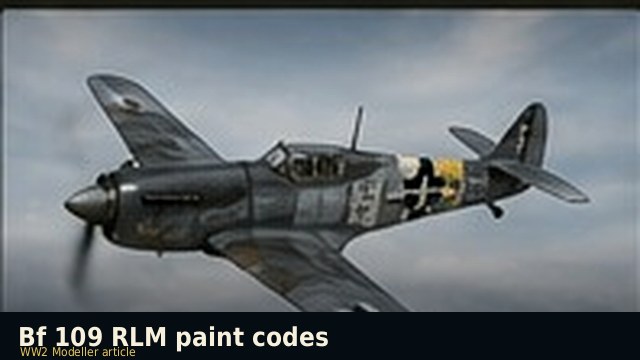
Bf 109 RLM paint codes — Humbrol, Tamiya, Vallejo & AK matched
The Reichsluftfahrtministerium (RLM) colour system governed every paint applied to German aircraft from 1935 onwards. For Bf 109 modellers this means navigating two distinct palettes — the early splinter scheme of RLM 70/71/65 used on the Emil, and the later mottled scheme of RLM 74/75/76 that became standard from the Friedrich onwards. Here are the best matched codes across all four major model paint brands, with notes on application and the most common mistakes.
RLM colour chips were issued to manufacturers with strict tolerances, but real-world variation was significant. Different production batches, different manufacturers and different theatres all produced aircraft that deviated from the standard chips. The codes below represent the best modern interpretation of the original RLM references — they are not definitive absolutes, and slight variation between brands is entirely period-accurate.
One crucial point: RLM colours fade significantly in service, particularly the upper surface colours. A freshly painted Bf 109E would look noticeably darker than the same aircraft after a month of Channel Front operations. Lightening your upper surface colours by 10–15% before application is historically defensible for any subject past its first few weeks of service.
The Bf 109E wore a hard-edged splinter scheme on the upper surfaces using RLM 70 Schwarzgrün (Black Green) and RLM 71 Dunkelgrün (Dark Green), with RLM 65 Hellblau (Light Blue) on all undersurfaces. The demarcation between upper and lower surfaces was a hard, sprayed line — not soft-edged.
A very dark, near-black green. One of the two upper surface splinter colours on the Emil. In photographs it often reads as near-black. Do not lighten this colour excessively — it should read dark against the RLM 71.
A mid dark green, slightly warmer and lighter than RLM 70. The two upper surface colours should show clear contrast in raking light. Battle of Britain Emil markings used both colours in the classic diagonal splinter pattern, with the division running roughly diagonally across the fuselage.
The standard Luftwaffe underside colour for the early war period. A medium-light sky blue. Also used on the underside of wing surfaces visible from below. The spinner of most Battle of Britain Bf 109Es was painted in unit colours over this base.
From the Bf 109F the splinter scheme was replaced by a softer, mottled appearance using RLM 74 Graugrün and RLM 75 Grauviolett on the upper surfaces, with RLM 76 Lichtblau on undersurfaces and as the base for fuselage mottling. The hard demarcation line was replaced by a soft, mottled transition — one of the most characteristic and challenging effects in Luftwaffe modelling.
A mid grey-green. Cooler and more neutral than the RLM 71 it replaced. Used in the upper surface demarcation areas and as the primary mottling colour on the fuselage sides of late-war Gustavs.
A cool grey with a distinct violet undertone. Genuinely unusual colour — the violet cast is subtle but clearly visible in good light. Used alongside RLM 74 for the upper surface mottling and demarcation. Often confused with a neutral grey by modellers — the violet note is important to get right.
A pale grey-blue that replaced RLM 65 as the standard underside colour. Lighter and cooler than RLM 65. Also used as the base coat on fuselage sides before the mottled application of RLM 74 and 75. Getting the underside/base coat right is essential because all the fuselage mottling sits over it.
Bf 109Es and Fs serving in North Africa from 1941 wore a desert scheme: RLM 79 Sandgelb (sand yellow) as the base, overpainted with RLM 80 Olivgrün (olive green) in irregular patches, with RLM 78 Himmelblau (sky blue) on undersurfaces. This was often applied in the field with varying levels of coverage.
RLM 79 Sandgelb: Tamiya XF-59 Desert Yellow, Vallejo 70.916 Sand Yellow, AK AK2079
RLM 80 Olivgrün: Tamiya XF-58 Olive Green, Vallejo 70.888 Olive Grey, AK AK2080
RLM 78 Himmelblau: Tamiya XF-21 Sky, Vallejo 70.961 Sky Blue, AK AK2078
From the winter of 1941–42 onwards, Bf 109s on the Eastern Front often received a temporary whitewash applied over the standard scheme. This was chalk-based or diluted white paint, brushed on roughly and wearing off rapidly. Represent this with very thin Humbrol 34 White or Vallejo 70.951 White thinned to near-wash consistency, applied with a wide brush and allowed to show the base scheme through it in worn areas.
The Bf 109 cockpit interior, instrument panel, seat and structural framework were painted RLM 66 Schwarzgrau (Black Grey) from early 1941 onwards. Earlier aircraft used RLM 02 Grau. RLM 66 is a very dark near-black grey with a slight warm undertone. Matched codes: Humbrol No.32 Dark Grey, Tamiya XF-63 German Grey, Vallejo 70.862 Black Grey, AK AK2066.
The Bf 109F/G/K mottled fuselage scheme is best achieved with an airbrush using reduced air pressure (10–12 psi) and a thinned paint mix. Apply the RLM 76 base coat first. Then add the mottling with RLM 74 and 75 using a very small brush tip opening, holding the airbrush 2–3cm from the surface. Work in short, circular movements. No two aircraft were identical — use reference photographs of your specific marking as a guide rather than trying to match a diagram exactly.