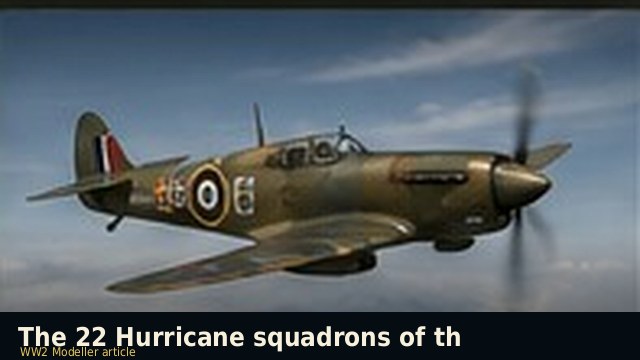
The 22 Hurricane squadrons of the Battle of Britain — a guide for modellers
Twenty-two RAF squadrons flew Hawker Hurricanes in the Battle of Britain, accounting for over 55% of all RAF victory claims. Understanding which squadron you're modelling — its group, base, codes and pilots — is the foundation of any serious BoB Hurricane build. This guide maps all 22 units with the key details a modeller needs.
Fighter Command was divided into Groups, each covering a geographic area. The group your squadron belonged to determines its role in the battle, its likely flying tempo and the airfield mud colour you should apply to the undercarriage.
11 Group (AVM Keith Park) — Southeast England, the front line. The most heavily engaged. Squadrons here flew 4–6 sorties per day in August–September. Heavy wear on aircraft.
10 Group (AVM Quintin Brand) — Southwest. Covered Portsmouth, Southampton and Bristol. Less intense than 11 Group but engaged Luftflotte 3 from Normandy.
12 Group (AVM Trafford Leigh-Mallory) — Midlands. The Big Wing controversy. Reserve role, rotating south when called. Less operational wear on aircraft.
13 Group (AVM Richard Saul) — North. Scotland, North England. Defeated the disastrous Luftflotte 5 Norway attacks on 15 August.
These units bore the heaviest burden of the battle. Their aircraft showed the greatest operational wear — paint fading, retouched codes, heavy exhaust staining, accumulated airfield contamination.
One of the most experienced units, blooded in France. 155 claims — third highest in the battle. The most covered Hurricane unit for decals: Xtradecal X48147, X72113 and multiple Barracuda sheets. Serial P2923 coded JX-B is the standard reference aircraft.
Officially the most successful Fighter Command squadron in the first half of the battle. Michael Crossley (22 kills — top Hurricane ace of 1940) and Peter Brothers flew here. The Hawkinge B-Flight photograph (29 July 1940) showing GZ-V is the most reproduced image of the entire battle. Xtradecal X72117 covers this unit.
First to intercept cross-Channel raids on the south coast. Tom Dalton-Morgan (11 kills) was among the top Hurricane scorers. Xtradecal X48147 and X72117 both cover 43 Sqn.
Defended eastern Essex. North Weald was bombed on 24 August. Xtradecal X72117 covers N3522 US-P. Serial N3522 coded US-P is the primary reference aircraft.
Peter Townsend (DSO DFC) led 85 Sqn. R.H.A. Lee (13 kills) was the highest-scoring pilot at the time of his death on 18 August. Multiple decal sheets: Xtradecal X72225 (P3166 VY-Q Townsend), X72117 (VY-R A.G. Lewis). Croydon was bombed 15 August.
Pioneered head-on attacks against bomber formations — adopted across Fighter Command. 134 claims — highest of any Hurricane unit. Xtradecal X48147 covers this unit.
County of Gloucester Auxiliary. 131 claims. 'Ginger' Lacey scored 15 kills here before moving to 151 Sqn. Xtradecal X72225 covers V6665 SD-B.
The unique Red Devon Clay station — see the weathering article for details. Ian Gleed wrote 'Arise to Conquer'. Xtradecal X48144 covers P2798 LK-A (Gleed's aircraft).
Covered Hampshire and Dorset for 10 Group. Engaged Luftflotte 3 attacks on Southampton and Weymouth.
The 'Canadian Squadron' under Bader. Anchor of the Big Wing controversy. V7467 LE-D (Bader's aircraft) is the most modelled Big Wing Hurricane. Xtradecal X48144, X72225 and X48146 all cover 242 Sqn markings.
Tom Neil's squadron — his memoir Gun Button to Fire is the finest first-person Hurricane account of the battle. Nicholson's VC was won here (16 August 1940). Serial P3616 coded GN-F.